

 Quoted on SEO and content by the Shopify blog, MarTech, and other industry-leading publications

You don’t need a massive team to win at B2C SEO. You just need the right priorities.
We created this guide to help small brands with small budgets understand how to get the most out of search engine optimization.
Key Takeaways from our B2C SEO Guide
- Small B2C brands have structural advantages in SEO, such as agility, niche focus, and site size, that can offset the budget gap with larger competitors.
- B2C brands should prioritize foundational moves, such as getting your site indexed, optimizing the pages closest to a purchase, and building a keyword strategy around long-tail commercial keywords over keywords with high search volume.
What Do We Mean by “SEO” in a B2C Context?
Whether you’re an ecommerce retailer or a direct-to-consumer brand, search engine optimization (SEO) has one purpose: connecting buyers with your products at the moment they’re looking.
That moment happens in traditional Google searches. It happens in AI Overviews where barely anyone clicks anything. It happens in ChatGPT, Gemini, and all of the other AI tools that people are using.
SEO is the work you do to show up in all of those places.
Note: If you run an online store, read our ecommerce SEO guide instead. It covers ecommerce-related topics like PLPs, PDPs, and faceted navigation in more depth than we do here.
What Makes B2C SEO Different Than B2B SEO?
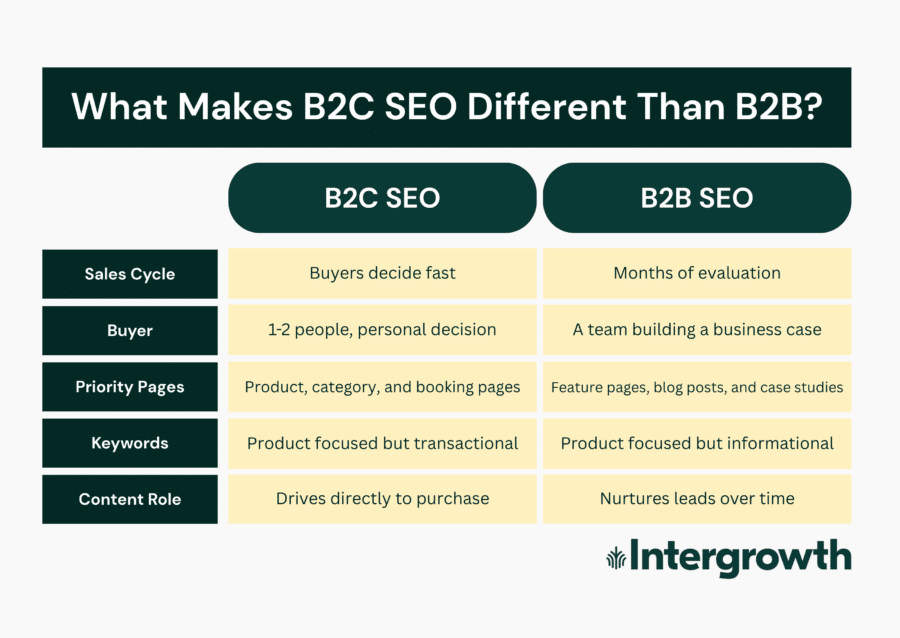
When someone searches “best budgeting app for families,” they’re not filling out a contact form. If they search “cheap travel insurance,” they’re probably buying today.
B2C purchases are personal. The sales cycles are shorter. The buyer isn’t sitting through three rounds of demos or building an internal business case or consulting a procurement team (aside from maybe a spouse if they’re buying a couch or something).
B2B companies have a different relationship with SEO. Their customers spend weeks evaluating options, comparing vendors, and building a business case before signing anything. A SaaS company has time to publish educational content, capture qualified leads, and nurture them toward a sale.
B2C buyers move through that process faster, often in a single session. The SEO strategy has to look different. The pages that matter most aren’t blog posts. The keywords that drive revenue are the ones people search for right before they make a purchase decision.
Related: Ecommerce SEO vs. “Regular SEO” (and How AI Is Changing Them Both
Why Underdog Brands Have an Advantage When It Comes to B2C SEO
Smaller B2C brands often assume that budget will hold them back in search. It’s a real constraint, but a well-prioritized small brand has significant structural advantages:
- Agility: A small team can make decisions and execute faster than a large organization waiting on layers of approval.
- Focus: A brand that owns a narrow topic or niche can outrank a larger competitor that covers everything broadly and nothing deeply.
- Site manageability: Larger sites accumulate years of outdated content, broken pages, and structural problems. A smaller site is easier to maintain and optimize.
Search gives small brands a chance to close the gap between them and their largest competitors.
The B2C SEO Strategy That Works for Small Teams (and Small Budgets)
When it comes to optimizing for search, there’s no shortage of things you could spend your time on: SEO content strategy, technical audits, link building …
The question is what to do when you have limited resources.
The steps below are the highest-priority moves for a small B2C brand starting out or trying to get more out of search.
- Make sure Google can find your site and your important pages.
- Improve your site speed and mobile user experience.
- Optimize the pages most likely to drive a sale.
- Design a keyword strategy around commercial search intent.
- Publish content that attracts customers, not just browsers.
- Link your most important pages to each other.
- Get other websites to link to yours.
- Track the metrics that actually matter.
If you work through these and want to go deeper, the sections that follow cover more advanced work for teams with more bandwidth.
1. Make sure Google can find your site and your important pages.
Search engines like Google work by crawling the web and storing pages in an index, or a giant catalog they pull from when someone runs a search.
If a page on your site isn’t in that index, it won’t show up in search results and no one will find it.
Three things to set up if you haven’t already:
- Google Search Console: A free tool that shows which pages Google has indexed, which have errors, and where crawling problems exist. This is your baseline.
- A sitemap: A file that lists every page on your site you want Google to find. Most website platforms generate one automatically. Submit it in Search Console so Google knows about your important pages.
- Google Merchant Center: If you have an online store, this connects your catalog to Google and makes your listings eligible to appear in Shopping results (the listings that appear with images and prices at the top of many product searches). GMC is necessary for any proper ecommerce SEO audit.
Once these are in place, you’ll have a clear picture of what Google can and can’t see.
2. Make your site fast and mobile friendly.
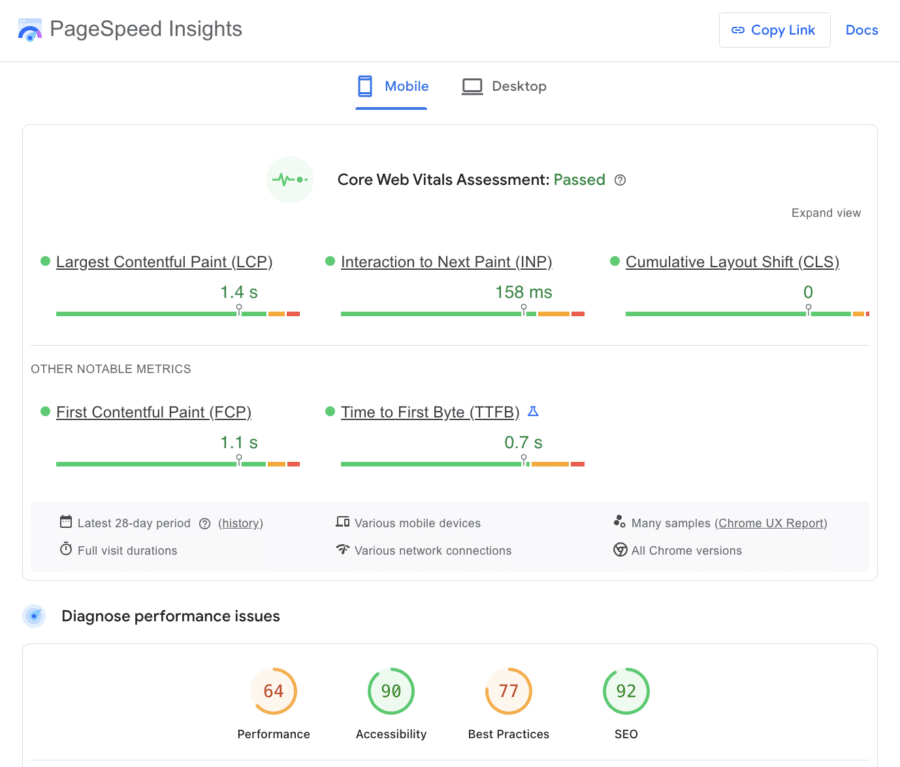
Google measures site functionality through a set of metrics called Core Web Vitals. It’s a rubric that evaluates how fast your pages load and how quickly they respond to user input. Pages that score poorly tend to rank lower, while pages that score well tend to get rewarded.
To see where your site stands, run your most important pages through Google’s PageSpeed Insights. It’s a free tool that flags specific issues impacting your site speed.
Pass the results to a developer. Most of the fixes come down to image compression, caching, and cleaning up code.
3. Optimize the pages most likely to drive a sale.
Not all pages on your site carry the same value. For most B2C brands, the pages closest to a purchase (product pages, booking pages, etc.) are where SEO shows the fastest ROI.
Start there. A well-optimized page tells Google what it’s about and gives the buyer everything they need to make a decision. That means:
- Clear, descriptive headers that include the term someone is most likely to search to find it.
- A concise URL that contains your target keyword.
- A catchy meta title that includes your target keyword.
- Original product descriptions written for your customer (not copied from a manufacturer’s site)
- Structured data markup that tells Google your product’s price and availability so that information can appear directly in search results.
- Customer reviews that signal high quality to both buyers and search engines.
Don’t try to optimize everything at once. Start with your best sellers and highest-traffic pages, and work down from there.
4. Design a keyword strategy around commercial intent
Keywords are the terms people type into search engines when they’re looking for something. The goal is to make sure the words on your page match the words potential customers use when they’re shopping.
Not all keywords will drive organic traffic. Someone searching “what is renters insurance” can get that answer from ChatGPT. Someone searching “affordable renters insurance for apartments” is looking at options. Both are relevant, but only one needs a product page optimized around it.
Here’s a free way to find high-value keywords: search the terms you think your customers use and look at what shows up.
- If the top results are product or service pages, that’s a buying keyword.
- If the top results are blog posts, save that for your own blog articles.
The more specific the term, the easier it is to compete for. You might lose to Wayfair and IKEA for “sectional sofa,” but you can win on a more specific, long-tail keyword like “affordable sectional sofa under $800 for small apartments.”
5. Prioritize blogs that attract customers, not just readers.
B2C content marketing is a long game. If you’re a small team with limited resources, your starting point matters.
The content worth prioritizing is the content that connects with buyers as they’re deciding what to buy. Two types tend to work best:
- Buying guides and comparisons: Content that helps someone choose between options. “The best midcentury modern stools for a kitchen island” connects with buyers who know what they want and need help finalizing their decision.
- Problem-solution content: Someone searching “how to furnish a small apartment on a budget” is trying to solve a problem and zeroing in on a purchase. A post that answers their question and points toward a specific product shortens the path.
This content also feeds AI search results. When someone asks ChatGPT about the best midcentury modern stools for a kitchen island, it pulls from sources that have already answered that question in detail.
Brands that publish specific, knowledgeable content about their products are more likely to get cited. Brands that don’t are easier to overlook.
6. Link your most important pages to each other.
Every link on your website is a signal. Internal links, which are links between pages on your own site, tell search engines which pages matter most and help buyers find the products they need.
A page with no internal links pointing to it is hard for Google to find and hard for customers to reach. For a small brand, buried pages are invisible.
Two things to check:
- Your most important pages should be reachable within two clicks from your homepage: If a key product or service page takes more than two clicks to find, add it to your navigation or link it from a page that’s already easy to reach.
- Your blog posts should link to relevant product and service pages: A post about furnishing a small apartment should link to your furniture collections. That connection helps buyers take the next step and helps search engines understand the relationship between your content and your products.
Internal linking is one of the faster wins in SEO. It doesn’t require content creation or outside help, just an audit of what you already have.
7. Get other websites to link to yours.
When another site links to yours, it’s a signal to search engines that your site is worth paying attention to. The more credible the source, the stronger the signal. Getting trusted sites to link to yours is called link building, and it’s one of the harder parts of SEO to cut corners on.
For a small team without a PR budget, there are a few realistic approaches:
- Earn links through original content: Data, research, and insider knowledge give other sites a reason to link to yours. Websites get links when they publish information other sites can’t.
- Get listed in directories and roundups: Gift guides and “best of” lists are actively looking for products and features. A single placement in the right roundup can significantly improve your search visibility.
- Recover broken backlinks: There might be sites linking to yours already. Use a tool like Ahrefs’ broken link checker to make sure those links point to working pages. Otherwise search algorithms don’t care about them.
If you can only do one of these, start with broken backlink recovery. It’s free, fast, and requires no fancy tools.
8. Track the Metrics That Actually Matter
A lot of SEO reporting focuses on traffic. People assume that more visitors mean the strategy is working. That’s not true.
A site can lose significant traffic but get more revenue from search, especially as AI overviews steal traffic from informational queries that were never going to convert anyway.
The number to watch is whether SEO is driving outcomes, not just sessions.
For a small team, you only need to track a short list of metrics:
- Organic revenue: How much revenue is coming directly from organic search? Set this up in Google Analytics 4 by connecting it to your conversion tracking.
- Conversion rate by landing page: Which pages are turning organic visitors into buyers, and which aren’t? Pages that drive traffic without sales may need some improvements, especially if they rank for sales-focused keywords.
- Keyword rankings: Are the pages you’ve optimized moving up in search results or down?
Google Analytics and Google Search Console give you access to this information for free. When you’re ready for deeper analysis, tools like Ahrefs and SEMrush offer more granular data.
Going Deeper into B2C SEO
The steps in the sections above are the ones to prioritize if you’re a small team in a competitive vertical.
Here’s a more comprehensive B2C SEO checklist for those with more time and money to spend on search.
Technical SEO for B2C Businesses
Technical SEO is the work of making sure search engines can find your pages, crawl them efficiently, and understand what they’re about.
Most technical SEO issues are invisible to visitors, which makes them harder to spot. Errors like broken redirects and misconfigured robots.txt files can drag your search rankings down over time, though, so they’re important to fix.
B2C marketing teams ready to go deeper should audit and address the following:
- Canonical tags: When duplicate pages exist across product variants or filtered URLs, it’s important to tell search engines which version of a page you want ranked.
- Redirect chains: URLs should point directly to their final destination, rather than to a series of redirected pages that add load time.
- Crawl errors: Check Google Search Console to verify that any pages you want to appear in search are doing so.
- HTTPS: Your site should load on https:// (rather than http://), or browsers will flag it as not secure.
- Robots.txt files: Make sure checkout and account pages are blocked from crawlers, and that your product, service, and blog pages are not.
- Schema markup: Most brands fail to set it up, but this easy-to-create code provides structured data to help search engines better understand your company, products, and content.
Technical SEO is most valuable when handled by someone with experience. The fixes are usually straightforward, but finding them requires knowing where to look.
On-Page SEO for B2C Brands
On-Page SEO is the work of making sure each page on your site clearly communicates what it’s about, both to search engines and the people who land on it.
The priority steps earlier in this guide cover the highest-impact items, but a more thorough on-page audit goes further.
A few additional items worth checking for:
- A well-organized heading structure: We touched on this above, but every page needs a single H1 that clearly describes its purpose (i.e., “Travel Insurance for Digital Nomads” or “Our Mortgage Insurance Cost Breakdown.”), followed by H2s and H3s that organize the content beneath it.
- Author credentials on blog articles: A biography showcasing your contributors’ experience helps to add credibility to your articles.
- Keyword cannibalization: When two pages on your site target the same search term, they end up competing for the same keywords. Each page should have a distinct keyword focus so search engines know which to show in each search.
- Alt text on images: Every image on your site should have a short, accurate text description of what it depicts. People with vision impairments use alt text to understand images, and search engines use it to index images in relevant image searches.
- Thin page content: Pages without much content struggle to convince Google they’re worth showing to searchers.
Ultimately, a clean on-page foundation helps every other SEO investment work harder.
Off-Page SEO for B2C Brands
Off-page SEO is about what the rest of the internet says about you. Search engines use external signals like links, mentions, and reviews to evaluate your site’s credibility and trustworthiness. A brand with a strong presence across third-party sources is more likely to get recommended than one that only optimizes its own website.
Customer reviews and backlinks are necessary to any B2C marketing strategy, but brands ready to invest more should consider channels like influencer marketing. A feature or review from a high-profile voice in your industry can improve your credibility faster than a dozen backlinks from websites no one reads.
Local SEO for B2C Businesses With a Physical Presence
If your business has a physical location or serves customers in a specific region, local SEO is an important investment. Small retailers have a big opportunity to outrank national competitors for local searches in ways that are more challenging for broad searches.
Start by auditing your Google Business Profile for the following:
- Accurate business information: Keep your name, address, phone number, and hours consistent everywhere they appear online.
- Photos: Businesses with photos tend to get more clicks and direction requests than those without.
- Customer reviews: The volume and quality of reviews (and whether you respond to them) affect your profile’s visibility in local search results.
Also: Yelp is the fifth-most cited source of information in Google’s AI Overviews, and we know that local citations (mentions of your business’s name, address, and phone number) are a ranking factor. Make sure you have a presence on there and other popular review sites.
Underdogs Can Win in B2C SEO
The gap between your brand and your biggest competitor is smaller than you think. Yes, large brands have bigger budgets. They also have bloated sites and slow decision making.
If you’re looking for a strategic partner to help you find the opportunities your biggest competitors are missing, give us a call.
SCALE YOUR ORGANIC TRAFFIC
Subscribe to our monthly newsletter