 Contributed to Content Marketing Institute, Recruiter.com, Startups.com, and dozens more publications
How to Win at Customer Acquisition in the AI Era
One of the top questions on marketers’ and business owners’ minds right now is how businesses can win customers in this new AI era.
Businesses ask us about this daily. We’ve written about how to build a brand in the AI era, what content marketing looks like in the AI era, and much more on this topic.
Today, we’re focusing on the broader question: how does my business win in the AI era?
Ready for the one-sentence answer?
This will consist of four steps:
- Defining what makes your business different from every competitor in your space.
- Communicating your positioning in as many online mediums as possible.
- Communicating who your business helps and who should consider a competitor.
- Making it easy for search engines like Google and LLMs like ChatGPT, Claude, etc. to understand and analyze online assets that you own.
Differentiating Your Business in the AI Era
How do you currently describe your business? Think of your 1-2 sentence pitch.
Now ask yourself: could the same pitch be used to describe any of my competitors?
If the answer is yes, your pitch needs work.
So, how can you solve this problem?
Let’s use Intergrowth as an example.
Our pitch is: Intergrowth helps B2C businesses that see their brand as an asset to get more customers through SEO and content marketing.
That’s a good starting point, but there are other agencies that this descriptor could apply to.
We take it a step further by internally documenting what sets us apart from other agencies, specific problems we help businesses solve, and characteristics of the businesses that we’re best suited to help.
More on that below.
But first, how much of the above do you have documented internally?
Recommended action steps:
If you don’t have clear answers to positioning questions like these:
- Take an hour to write down v1 of your answers. Revisit it a week later and see if you’ve changed your viewpoint on any of these answers.
- Ask your team these same questions. I found it helpful to ask about this in a survey that we sent out to the whole team. How do your team’s answers compare to your own?
If you have a clear picture of these answers:
- Ask your team on the spot to answer these questions. If they don’t know the answers, focus on communicating these positioning elements internally.
- Ask them if they know where they can find those answers in your internal knowledge base. If team members don’t know where to find the answers, confirm you have this documented internally and make it easier to locate. I find it effective to create a “Team Home” page in Notion that includes links to our mission, positioning, process docs, brand assets, and more.

Communicating Positioning Across Online Mediums
Once you’ve documented this positioning internally, shift your focus to consistency in positioning across every online channel you can think of.
The most important place to reflect that positioning is your website.
Then ask yourself: Is this positioning clearly stated in all of the following places?
- Your company social profiles (Facebook, LinkedIn, Twitter, Instagram, YouTube, etc.)
- Company email signatures?
- Google My Business and other local directories?
- Industry-specific directories/forums
Each of these is an additional data point that LLMs can cite when trying to understand your business. Make it easy for LLMs to find consistent messaging.
Let’s review how this looks in practice, using our agency as a case study.
How does Intergrowth communicate its positioning?
Here’s how to create a competitor comparison that actually differentiates you.
We created this breakdown that sets us apart from 90% of other SEO agencies and made it a key feature of our homepage. Notice how each item in the breakdown addresses a specific customer pain point, rather than generic features:
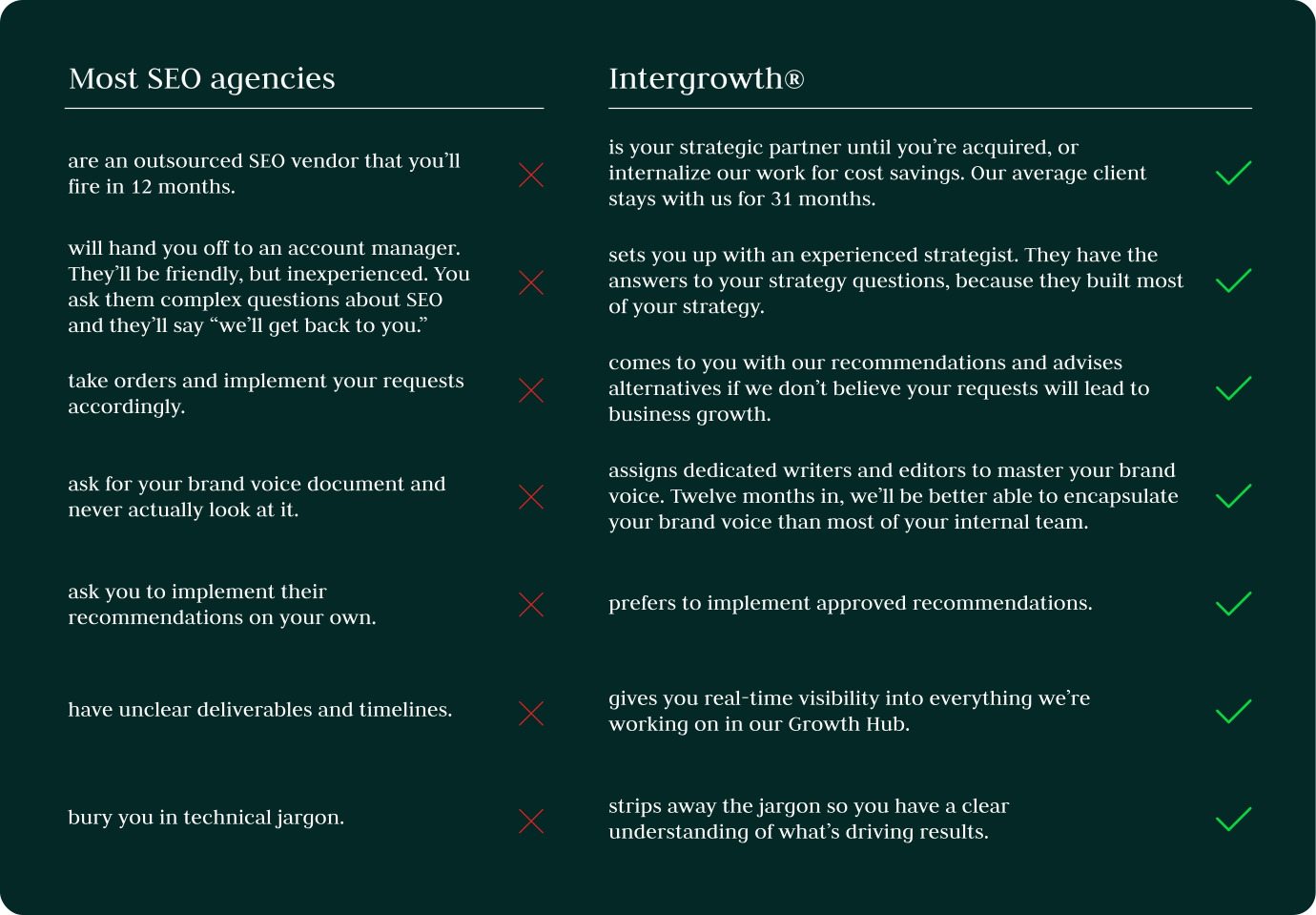
We then updated all of the above platforms we could find to reflect our positioning.
We also run a weekly podcast named Customer Growth Sessions that focuses on helping ecommerce business owners, and we have narrowed our content strategy to focus on creating content designed for ecommerce, insurance, and other B2C businesses.
Communicating Who You Help and Who You Shouldn’t Help
This might be the hardest part of the equation: sharing your strengths and weaknesses as publicly as possible.
Most brands put together a SWOT analysis (strengths, weaknesses, opportunities, threats) and build customer personas at some stage. They map out what makes them great, identify their weaknesses, and list traits of the customer they’re best suited to help.
But sharing this publicly is unheard of. Just look at any webpage of a business comparing itself to its competitors. The format is always the same:
- They list a handful of features
- They list out how competitors A-Z all have some of the features, but lack others
- They list themselves as having all of the features.
They might as well be saying, “We’re better than all of our competitors in every way, just trust us.”
LLMs can view all these feature comparison pages. Still, they place far more emphasis on gathering feedback from third-party platforms like Reddit, Quora, online review sites like Amazon and Capterra, and personal blogs.
So sure, you might convince a few customers who land on your comparison page, but you’re not fooling LLMs.
The businesses that will win are those that state where they’re better than the competition, where they’re worse than the competition, what type of customer they’re best suited to help, and what type of customer they’re least suited to help.
Every business struggles with these challenges. Let’s take a look at how we approach it.
Who is Intergrowth Best Suited to Help?
Here’s how we define our ideal customer (you can adapt this framework to your industry): B2C businesses — particularly those in ecommerce and insurance, generating $2-$20mm in annual revenue, that see their brand as an asset to their business. We specialize in helping those businesses acquire more online customers.
-> Put another way, we help small to medium-sized businesses selling to consumers, who care about their brand, get more online customers.
Every business should define its “non-customer,” or who they deliberately don’t serve. Here’s our list, which you can use to get a better idea of how to create your own.
We aren’t suited to help:
- $100mm+ annual revenue brands.
- Brands looking to monetize existing customers better, rather than gain new customers.
- Brands spending <$5k/month on online marketing.
- Brands that are comfortable with using AI to generate content for their website.
- Brands seeking a full-service agency to handle all areas of their marketing —we advise on all marketing, but only handle strategy and implementation for acquiring new customers.
- Brands looking for a multi-lingual agency. We occasionally advise businesses operating in different languages, but all of our editors and writers are native English speakers. We only write and optimize English content.
- Brands looking for the low-priced option.
Strong positioning becomes even more impactful when supported by an ecommerce customer acquisition agency that can translate your brand story into scalable growth.
Related: AEO Means Doing SEO Better
How Does Intergrowth Communicate This?
Post your differentiation prominently on your homepage. You’ll see a breakdown on our homepage as well about the most common problems we solve for clients.
Notice how each problem is specific enough that readers immediately know if it applies to them:

Beyond that, I regularly post on LinkedIn and in blog articles about who we’re best suited to help (and who shouldn’t be investing in SEO).
Making it Easy for Search Engines and LLMs to Understand Your Online Assets
Here’s where we have the strongest overlap between optimizing for search engines and optimizing for LLMs: confirming bots can find, crawl, and analyze your online assets.
Ensure that search engines and LLMs can discover (sitemaps and internal links), crawl (robots.txt), and index (meta robots and x-robots) pages on your website.
Full guide on Discoverability, Crawlability, and Indexability here.
From there, use schema markup to help search engines and LLMs better understand your business and various online channels connected to it. As a baseline:
- Use SameAs schema to connect your website, social media channels, podcast, and more to your business entity.
- Use Author schema for blog articles to provide more context about the authors on your website, their credibility, and connected social channels.
From there, focus on technical SEO (more context on technical SEO here).
Think of this as the engine maintenance side of owning a car. Lingering issues can cause your car to break down on the highway and will inhibit your driving for months before that. Technical SEO focuses on making it easy for search engines and LLMs to analyze your website.
We break down the most common (and highest impact) technical SEO issues we see in our Pareto Principle of SEO guide.
Next, add your positioning statement and additional context about your business into an LLMs.txt file.
You can find Intergrowth’s LLMs.txt file here as an example.
When creating your own, focus on the elements we included in ours:
- A brief description of your company
- Specific differentiators from your competitors
- What concrete problems you solve
- Your service offerings
- Your process
- Case studies
- Customer testimonials
- Key content pieces
- Basic contact and pricing information
Notice how each section uses specific details, rather than generic claims. This helps LLMs understand what makes your business distinct from the rest.
LLMs.txt files are a new concept, first proposed in late 2024. Best practices will change over time. For now, we’re treating this as a one-page text summary of your business that includes links to additional information to help LLMs better understand you.
The final step is ongoing hygiene.
I recommend running a consistent LLM Sentiment Analysis: asking various LLMs for their views on your brand.
Results will vary for each user. However, this is a phenomenal way to get feedback on:
- How clearly you’re positioning your brand.
- Inaccuracies in how LLMs perceive facts about your business (ex., founding year, employee count, etc.) and the sources that they pull that inaccurate information from.
- Weaknesses that LLMs perceive (and the sources they pull those weaknesses from).
Conclusion
Positioning is an ongoing process. Refining and communicating that positioning will never end.
If you found this helpful, subscribe to our monthly newsletter to read our latest insights.
Looking to partner with the team that preserves and futureproofs your customer acquisition in this AI era? Tell us about yourself and we’ll schedule a consultation to show you how we would help your business.
SCALE YOUR ORGANIC TRAFFIC
Subscribe to our monthly newsletter