 Contributed to Content Marketing Institute, Recruiter.com, Startups.com, and dozens more publications
I’ve gone back and forth on the concept of Answer Engine Optimization (AEO) a lot over the past two years.
My mindset has historically been that AEO is overhyped.
Yes, LLM adoption is skyrocketing. The value of getting your business recommended in LLMs grows more valuable by the day. But AEO is nowhere near as important as most people make it out to be.
As of January 2026, ChatGPT owns only a sliver of the search market share that Google does, and Google drives 132x more traffic to websites than ChatGPT. You’ll still see better ROI from focusing on SEO over an AEO.
That’s why I’ve been dismissing AEO.
But here’s the thing: this mindset misses the main benefit of AEO for customer acquisition.
AEO and SEO aren’t competing forces. AEO is what SEO looks like when it’s done better.
How LLMs Improved SEO
The rise of large language models helped us to evolve what “SEO” actually means.
SEO used to be about getting your site to rank in Google, Bing, and Yahoo.
Today, SEO is about optimizing for every tool that people use to find information and make purchase decisions: AI tools, Reddit, YouTube, Amazon, Instagram, and more. SEO has transitioned from search engine optimization to search everywhere optimization.
The best SEOs are adapting to become advisors across all stages of customer acquisition and digital marketing.
The best SEOs are advising clients on ways to improve the user experience and perceived trustworthiness once a customer reaches the web page, such as expanding FAQ sections to include answers to common customer questions.
What Information Discovery Looks Like Today
Information discovery is now a blended approach between AI search, Search Engines, social media, trusted blogs, and niche forums.
- People see an Instagram video from a friend about how much they love their air fryer.
- They go to an LLM asking, “What questions do I need to consider before purchasing an air fryer?”
- They go to Reddit to see which air fryers Reddit users recommend
- They go to Google to read product comparisons of different air fryers.
- They go to the air fryer company’s website and make a purchase.
What Does SEO Look Like in 2026 and Beyond?
Search everywhere optimization focuses on everything baked into traditional SEO, along with a handful of new items.
We’ve long said that every SEO best practice boils down to three SEO principles:
- Authority: how trustworthy do search engines consider your website to be?
- Relevancy: what do search engines perceive your website and brand to be about?
- Crawlability: how easy is it for search engines to find and analyze your website?
These three principles still hold with the updated SEO model, but SEOs need to consider four additional elements to excel in 2026 and beyond:

1. CRO and UX
Historically, SEOs could get away with treating website sessions and keyword rankings as their main success metrics.
“Organic traffic and rankings are up? Great, it looks like SEO is working exactly as desired. Leads are flat? We can shift content strategy to bottom-of-the-funnel landing pages, but this is likely a website design issue. Better to take this up with the design team.”
— every SEO, pre-2025
In the past few years, we’ve seen the percentage of searches that result in clicks shrink as AI Overviews become more common in Google Search results.
Brands still trying to measure success through website sessions are struggling to justify their work.
SEOs are now being forced to ask deeper questions about conversion rates: if we’re ranking first on Google for our primary search theme, but aren’t seeing significant revenue growth, what’s preventing users from converting?
2. Greater Emphasis on Positioning
Positioning used to be a branding question.
Our team expected clients to have their brand positioning defined before working with us.
SEOs, including our team, need to play a larger role in helping businesses define and communicate their positioning. Clear positioning gives generative AI systems a consistent set of sources to reference in understanding what a business does and what makes it unique.
We did a deep dive on Positioning in the AI Era here.
3. Influencing Citation Sources and Secondary Search Platforms
The days of optimizing a website for only Google are over.
In the past, SEO success meant writing a blog article that ranked on page one of Google. The future of SEO is about cross-channel brand visibility: injecting your brand into every source users go to for information.
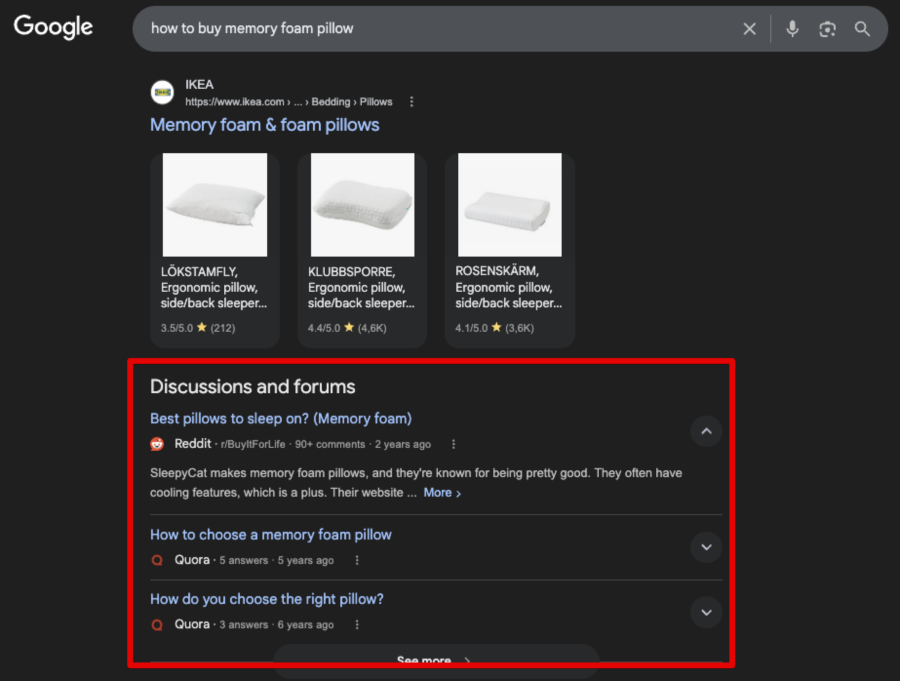
As you brainstorm your next blog article, go to a search engine results page (SERP). What other platforms appear in the top 10 results for the search theme you’re hoping to rank for?
- Does a TikTok search page show up?
- Does a Pinterest board show up?
- Are Reddit and Quora showing up?
- Are YouTube videos showing up?
Now go to an LLM.
Try several different prompts to search for information on the above topic. Note which sources are cited in the response.
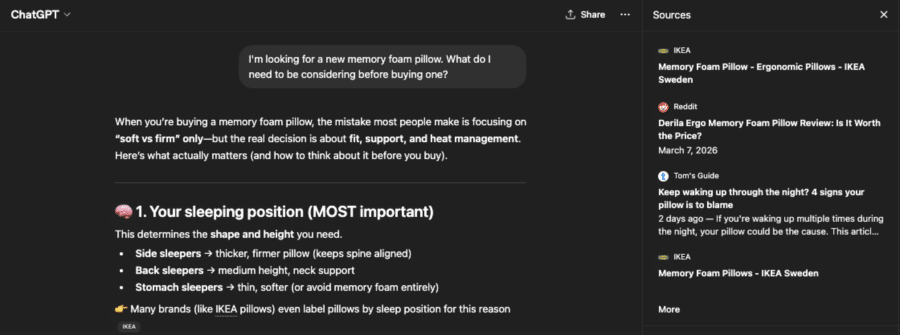
Now you’re left with a list of secondary platforms that get traffic from traditional search engines and are used as citation sources by LLMS.
Inject your brand into these sources.
- For forums like Reddit or Quora, set aside time to share snippets of insights from your educational article in those posts.
- For Pinterest boards, create graphics for your article and share them on Pinterest.
- For YouTube results, create a long-form YouTube video where the author of the article discusses the contents of the article.
- For TikTok search pages, create a series of short-form videos where the author of the article speaks to various angles of the article, likely follow-up questions, and more that you can post on TikTok.
- For publisher sites, look for ways to earn inclusion of your brand in their article.
Need help getting your brand in the world’s largest publications? See how we help brands get featured in publications like Forbes and Business Insider every day through Expert Commentary PR.
4. Optimizing Content for LLMs
The most popular content optimization tool over the past decade has been term frequency, inverse document frequency (TF-IDF). TF-IDF is a statistical analysis method used to determine which keywords/themes to include on a page to increase the likelihood that your content will rank for specific keyword themes.
LLMs have introduced a new approach called Query Fan-Out.
Query Fan-Out is a process that LLMs use when searching online for information to respond to a prompt. Query Fan-Out is a process where LLMs go to a search engine and search for a handful of themes they believe will yield sources that help them provide direct answers to a relevant question.
SEOs now have the opportunity to analyze the exact terms LLMs search for during this process.
ChatGPT currently provides this data for those comfortable using Chrome DevTools. However, as the team at Promptwatch reported, OpenAI has started to hide this data with GPT-5.4, so this may disappear soon.
As of April 2026, Google still allows us to extract this data. My recommendation is to use iPullRank’s Qforia tool to pull this information.
How Does Query Fan Out Work in Practice?
Let’s say you want to be a recommended or cited source for queries related to casual men’s dress shoes.
You run Query Fan Out to see which specific queries LLMs use to pull together their recommended shoe brands.
You now have a list of search queries to focus on ranking for in traditional search engines.
Create a robust educational resource designed to rank in traditional search engines for each query. Now go to #3 above and focus on getting your brand included in the relevant citation sources that also appear in search results.
How Do You Set Up Your Brand for Success?
Start by understanding how your target audience discovers information today.
SparkToro is a great source for this. Identify the channels for your brand to prioritize based on how your customers find information.
For example, here’s a snapshot of the casual men’s dress shoes used above.
- This audience uses LikedIn 10% more and Reddit 6.3% more than the average U.S. individual
- This audience uses ChatGPT 10.9% less than the average U.S. individual, instead turning to Yahoo 22.6% more than the U.S. average.
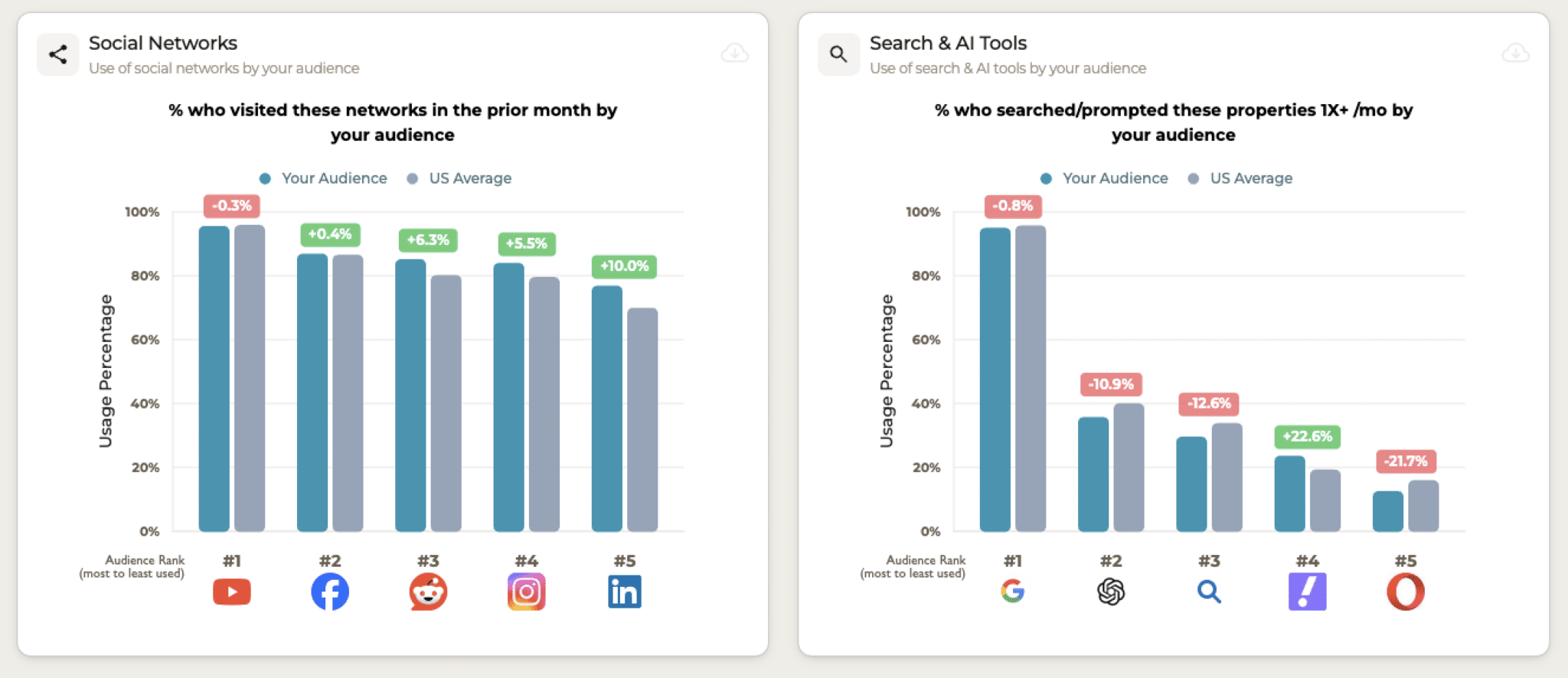
Engage in these channels. Share your best insights and get your brand involved in the right types of conversations for your business. Generate press around your brand and earn backlinks in the high-quality publications that AI platforms look to for signals of trustworthiness.
Make it easy for LLMs and search engines to analyze your website. Invest in technical SEO initiatives like Core Web Vitals and building structured data (ex. schema markup).
Continue building topical authority for your brand. This should be at the heart of your content creation strategy. Topical authority has long been the best tool for small brands to outrank much larger players. Topical authority will only become more important in this new AI Era.
In the midst of this, ensure you communicate your positioning clearly across every channel you control.
Conclusion
Information discovery is evolving rapidly.
If you’re looking to future-proof how customers find you online, contact us today. We help B2C companies that treat their brand as an asset get more customers from SEO, content marketing, and Meta Ads.
P.S. A huge thank you to Chris Zacher for all your help with structuring this article and talking through all these concepts.
SCALE YOUR ORGANIC TRAFFIC
Subscribe to our monthly newsletter