

 Contributed to Content Marketing Institute, Recruiter.com, Startups.com, and dozens more publications

I hear a lot of marketers talking about LLM visibility and prompt tracking.
It’s a quantitative data point: do you show up in AI search or not?
I don’t hear many marketers talking about how you show up.
Let’s say your prompt tracking tool says you show up 25% of the time when people use queries like “razor blades” in their prompt.
It sounds great on paper, but what if those mentions are negative? What if large language models are telling customers to avoid your razor blades?
That’s where LLM Sentiment Analysis comes in.
LLM Sentiment Analysis gives you a workflow to collect qualitative snapshots of how LLMs feel about your business on a recurring basis, to pair with your rank tracking data.
LLM Sentiment Analysis consists of four parts:
- Brand Association Audit
- Factual Accuracy Audit
- Negative Sentiment Audit
- Product Recommendation Audit
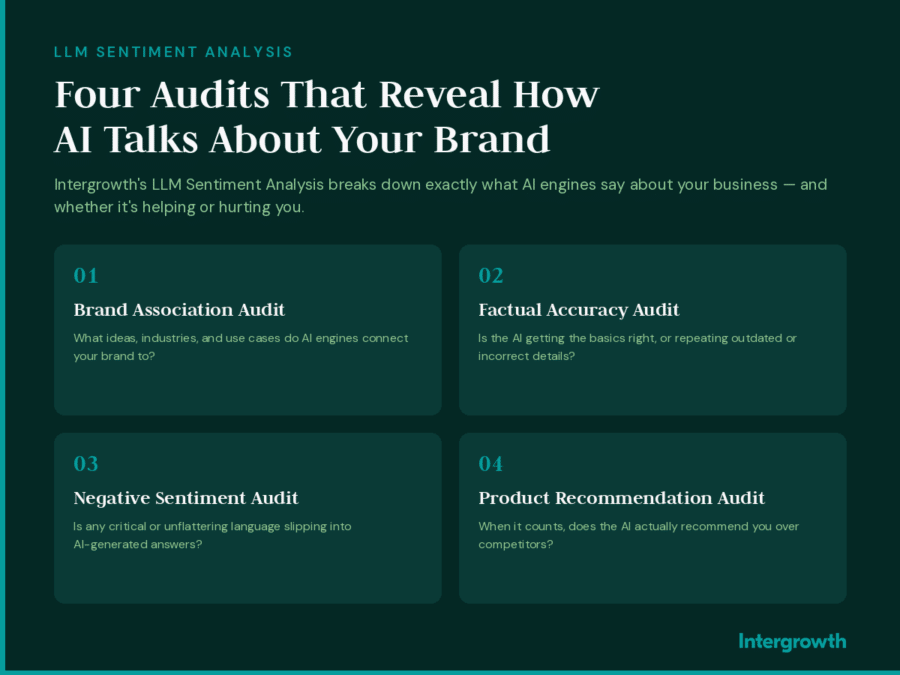
We’ll dive into each part of the audit, breaking down how to prompt and what to look for in each stage.
Quantitative tools tell you whether you showed up. They don’t tell you if that’s a good thing or a bad thing.
Showing up in 25% of responses means nothing if the LLM is steering shoppers toward a competitor, or actively warning them off your product.
P.S. I did a deep dive on LLM Sentiment Analysis on our podcast. Check out the full video here.
1. Brand Association Audit: Does the LLM Even Know Who You Are?
Open your LLM of choice and ask it a simple question: “What is [Your Company Name]?”
If the LLM associates your company name with your business, proceed to step two.
If a different company shows up (a bigger brand with a similar name or an unrelated business that happens to share your name), you’ve found a real problem. That’s a brand awareness gap, and it’s costing you every time someone asks an LLM about you by name.
Why does this happen?
LLMs generate responses based on how frequently and clearly your brand appears across the content they were trained on and can retrieve. If a bigger or older company has more (or clearer) presence tied to your name, the LLM defaults to that business instead of yours.
Recommended action steps:
- Search “What is [your brand name]?” across ChatGPT, Claude, and Google’s AI Mode, at minimum.
- If your company doesn’t show up, document what brand the LLM associated with your company name and why the confusion is likely happening (name overlap, similar industry, etc.).
- Make more content that explicitly ties your company name to what you actually do. Three good places to start are adding schema markup (particularly SameAs schema), listing your business on industry directories, and generating press mentions for your brand.
- Re-run this audit monthly. Brand association shifts as your content footprint grows.
2. Factual Accuracy Audit: Does the LLM Have Your Facts Right?
Once an LLM knows who you are, look for any factual inaccuracies in its understanding of your brand.
Ask it to provide an overview of your business. Typically, you’ll see the LLM start with a company overview (founding date, employee count, funding rounds, etc.), followed by an overview of the products or services you sell.
Wrong answers are usually traceable to a source with inaccurate information. Find that source and you can correct the issue.
How do you find the source? Ask the LLM directly. Most tools will tell you where they pulled a claim from, or at least point you toward the type of source (a review site, a forum, an outdated press release) if you ask a follow-up.
Recommended action steps:
- Ask LLMs to give an overview of your business.
- Flag every inaccuracy and ask the LLM what it’s basing that answer on.
- Correct the source directly where possible (an outdated Crunchbase listing, a stale About page, an old press mention).
- Where you can’t fix the original source, publish a clear, updated version of the correct fact on your own site.
3. Negative Sentiment Audit: What’s Driving How LLMs Talk About You?
Ask an LLM for its honest perception of your brand or product, then look at what it cites to back that perception up.
Three things to look for:
- Which communities get cited. Community sentiment carries real weight in how LLMs characterize a brand. Which subreddits are referenced? Which Quora posts are quoted?
- Which review sites get cited. Trustpilot, G2, or an industry-specific platform, whatever comes up repeatedly.
- Which individual reviews or articles get cited. These are often the specific complaints shaping the LLM’s answer.
Don’t seed positive comments or try to manipulate negative threads if you find them. Treat this as a genuine customer service opportunity instead. Find the people who are frustrated, understand what they’re frustrated about, and fix it or point them to any fixes that already exist (an old complaint about a bug that’s since been patched, for example).
Work to get reviews on the platforms that LLMs cite most often. If Trustpilot keeps coming up, focus your review requests on Trustpilot. If some obscure niche platform keeps showing up instead, that’s where your energy needs to go.
Recommended action steps:
- Ask LLMs for their candid perception of your brand, and note all cited sources.
- Resolve legitimate, current complaints directly with the customers who left them.
- Correct outdated complaints with current information where the underlying issue has been fixed.
- Redirect review generation efforts toward whichever platforms LLMs are actually citing.
4. Product Recommendation Audit: Are You the Recommendation, Broad or Narrow?
This is the layer that actually drives revenue. Ask your LLM of choice a broad question a customer might ask: “I’m looking to buy new razor blades. What brand should I consider?”
Are you in the answer? If not, who is, and what do they have that you don’t yet?
Then get narrow. Instead of asking about razor blades generally, ask about razor blades for a specific use case you specialize in.
Showing up for the broad prompt is a brand awareness win. Showing up for the narrow prompt is where the long-term value actually lives.
Your visibility in the narrower prompts also serves as a gut check for how clear your brand positioning is.
Why does narrow matter more? Broad recommendation slots are crowded, dominated by whoever has the most overall brand mass. Narrow, specific use cases have far less competition, and they’re exactly the moments when a shopper is closest to buying.
Recommended action steps:
- Test both broad and narrow prompts across every LLM you’re tracking.
- If you’re missing from broad results, note who’s showing up instead and why.
- Prioritize narrow recommendation visibility first. It’s more attainable and more valuable.
- Invest in Expert Commentary PR and ongoing educational content addressing the specific pain points your narrow use case solves.
Why This Only Works as a Recurring Practice
Run any of these four audits once and you’ll get one answer. Run it again tomorrow and you might get a different one.
LLMs are probability engines, not databases. They don’t store a fixed opinion of your brand and recite it on command. Every response is generated fresh, which means the exact same prompt can produce a different answer an hour later.
SparkToro tested this at scale. Rand Fishkin had 600 volunteers run 12 prompts across ChatGPT, Claude, and Google’s Gemini, generating 2,961 total responses.
The odds of getting the same list of brands twice were less than 1 in 100. The odds of getting the same order twice were closer to 1 in 1,000.
So does that mean the four audits above are useless? No.
It means a single response isn’t the finding. The pattern across many responses is the finding.
Run the Brand Association Audit once and get the right answer. That tells you almost nothing.
Run it 20 times over a month and get the right answer 18 times. Now you have a real signal about your LLM brand visibility.
The same logic applies to all four audits. One negative sentiment response might be noise. A negative response that shows up consistently across dozens of prompts is a pattern worth fixing.
Recommended action steps:
- Disable each LLM’s memory of previous conversations and run these four audits. Ask other members of the team to run these audits as well.
- Track results across ChatGPT, Claude, and Google’s AI Mode, not just your preferred tool.
- Repeat the full framework monthly and log results so you can see trends instead of single data points.
- Treat any one response as a data point, never as the answer.
This is also why pairing LLM Sentiment Analysis with quantitative rank tracking matters. Rank tracking tells you the frequency. This framework tells you what’s actually happening inside that frequency, and frequency without context is just a number.
Quantitative tracking tells you whether you show up. LLM Sentiment Analysis tells you how, and whether that’s good news.
Run all four audits (Brand Association, Factual Accuracy, Negative Sentiment, Product Recommendation) on a recurring basis, across multiple LLMs, to catch misinformation, fix positioning gaps, and find out if AI is recommending you.
A lot has changed in how customers find you online. Intergrowth helps ecommerce and other B2C businesses to profitably get more customers in the AI era through SEO/AEO and Meta Ads.
Contact us to see how we can help brands like you future-proof how customers find you.
SCALE YOUR ORGANIC TRAFFIC
Subscribe to our monthly newsletter